Latitude 64
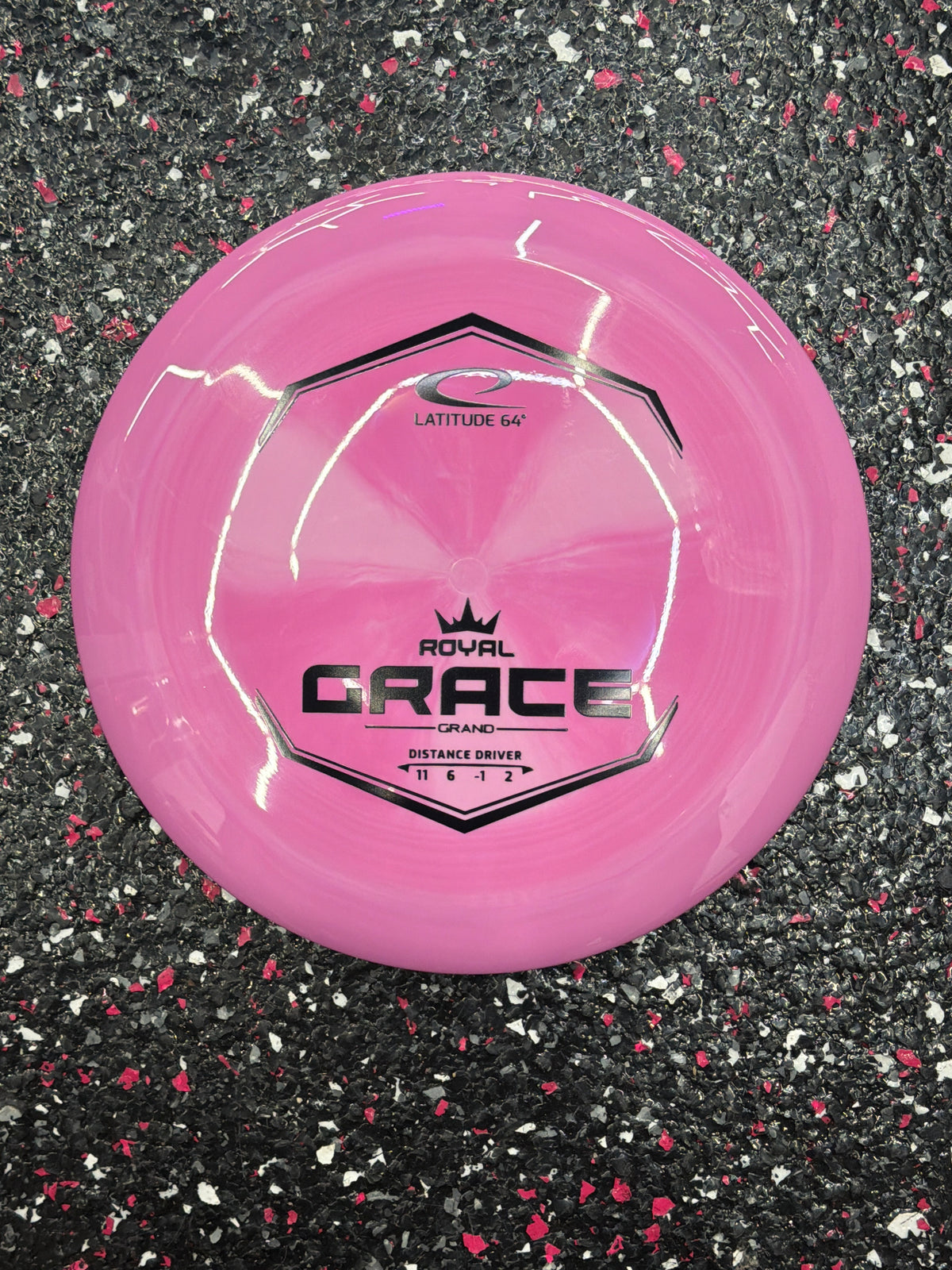
11/6/-1/2 Latitude 64 Grace
11/6/-1/2 Latitude 64 Grace
Couldn't load pickup availability
The Grace Under Pressure
There is a particular kind of disc golfer who walks up to the tee with a plan, a backup plan, and a third plan that mostly involves hoping the trees cooperate. The Latitude 64 Grace is for the player who wants a distance driver that can cover ground without feeling like it needs a runway, a tailwind, and a small legal team to negotiate the landing.
The name fits the goal: make a powerful throw look controlled. The Grace sits in that appealing space where a distance driver can still be useful for shaping lines, pushing down a fairway, and getting extra reach without automatically demanding the most aggressive arm speed in the group. This is BDLD's original take on the mold, not a claim about the manufacturer's naming history: the mission is to make distance look less like a wrestling match.
Flight: 11 / 6 / -1 / 2
Speed 11: This is a distance driver, so it generally rewards a reasonably clean release and enough speed to get it moving. Players moving up from fairway drivers may appreciate the added distance potential, but speed 11 does not magically add power to a throw. If your release is inconsistent, a slower disc may still travel farther because it gets up to speed more easily.
Glide 6: The glide rating points toward a disc designed to carry. With a good launch, the Grace can keep moving forward rather than dropping out of the sky as soon as it loses some speed. That extra carry can be helpful on open fairways and longer placement shots. It also means you should plan for the disc to keep traveling: aim with the landing zone in mind, not just the first gap.
Turn -1: A -1 turn suggests a modest amount of high-speed turn for many players, rather than a strongly understable driver. With enough power and a clean angle, it may drift or push right for a right-hand backhand throw before beginning its finish. Lower-power throwers may see less turn and more of a forward push followed by fade. Nose angle, release angle, wind, weight, and plastic all influence what happens in the air.
Fade 2: The fade rating suggests a dependable but not extreme finish. Expect the disc to work back toward the left for a right-hand backhand throw as it slows, though the amount of finish will vary with power and conditions. For right-hand forehand throws, the direction is reversed. The Grace can be useful when you want a distance driver to finish with purpose without choosing a very overstable mold for every shot.
Who may like it? Intermediate and experienced players looking for a workable distance driver are natural candidates. Newer players can certainly try it, but should compare actual results with a fairway driver or a slower control driver. If the Grace consistently fades early, that is useful feedback about available power, nose angle, or the conditions—not a personal failure and definitely not a reason to start throwing harder at every tree.
Backhand, forehand, and wind: Backhand throwers can explore straight distance, controlled hyzer lines, and gentle shaping depending on their power and release. Forehand players with a smooth release may find it useful for pushing forward before the finish; players who torque the disc heavily should test it rather than assume the numbers guarantee a specific flight. In a headwind, any disc can behave more understable and less predictable, so choose angles conservatively. A tailwind can reduce turn and make a disc finish sooner. Flight numbers are a guide, not a flight warranty.
Best Uses
- Controlled distance drives on open fairways where a long forward push matters.
- Long placement shots that need more reach than a typical fairway driver.
- Gentle shaping lines for players who can control release angle and speed.
- Hyzer drives that need a reliable finish without an extremely overstable disc.
- Straighter distance lines for throwers whose power matches the mold.
- Long approaches when the landing zone is wide and a driver-like carry is useful.
- Learning how a speed-11 driver responds to nose angle and release angle.
- Tailwind drives where added carry can help cover extra ground.
- Open-course tee shots where there is room for the disc to glide forward.
- Forehand distance attempts for players with a smooth, repeatable release.
- Backhand distance shots where a modest turn and controlled fade fit the line.
- Field-work sessions comparing plastics, weights, and release angles.
- Building a distance-driver slot between a very neutral driver and a more overstable option.
- Placement drives that prioritize a predictable landing area over maximum-risk distance.
- Practicing wind awareness by comparing flights in calm conditions and light breeze.
BDLD Real Talk
The Grace is worth considering if you want a distance driver that aims for useful carry and a manageable finish. The important word is aims: flight numbers describe a general design target, not a promise that every player will get the same S-curve. Someone with modest power may see a much straighter-to-fade flight than a high-power thrower. Someone with a nose-up release may watch that beautiful glide turn into a high, short flight that finishes early.
Don't buy a speed-11 disc just because the number looks like a promotion. Buy it because it gives you a shot you can actually use. If your fairway driver is currently outdistancing your distance drivers, spend some time cleaning up your release before adding more speed. If you already have a reliable high-speed driver that turns too much or fades too hard for the line you need, the Grace may offer a useful middle ground—but test it against the discs you already trust.
Because this listing covers multiple plastics, the variant you select matters. Plastic, weight, color, and individual run can all affect feel and sometimes flight. Pick the exact variant that matches your preference, and avoid assuming that the photo or name alone tells the whole story. At BDLD, the goal is to help you find a disc you can throw well, not to convince you that one mold solves every problem on the course.
Bottom Line
The Latitude 64 Grace is a speed-11 distance driver with flight numbers of 11 / 6 / -1 / 2, built around glide, workable turn, and a controlled finish. It is a strong candidate for players seeking useful distance without jumping straight to an aggressively overstable option. Choose the plastic and weight that fit your hand and game, give it clean form, and judge it by the flights you can repeat. Graceful distance is still distance—and it beats wrestling a disc into a line it never wanted to fly.
Share