Latitude 64
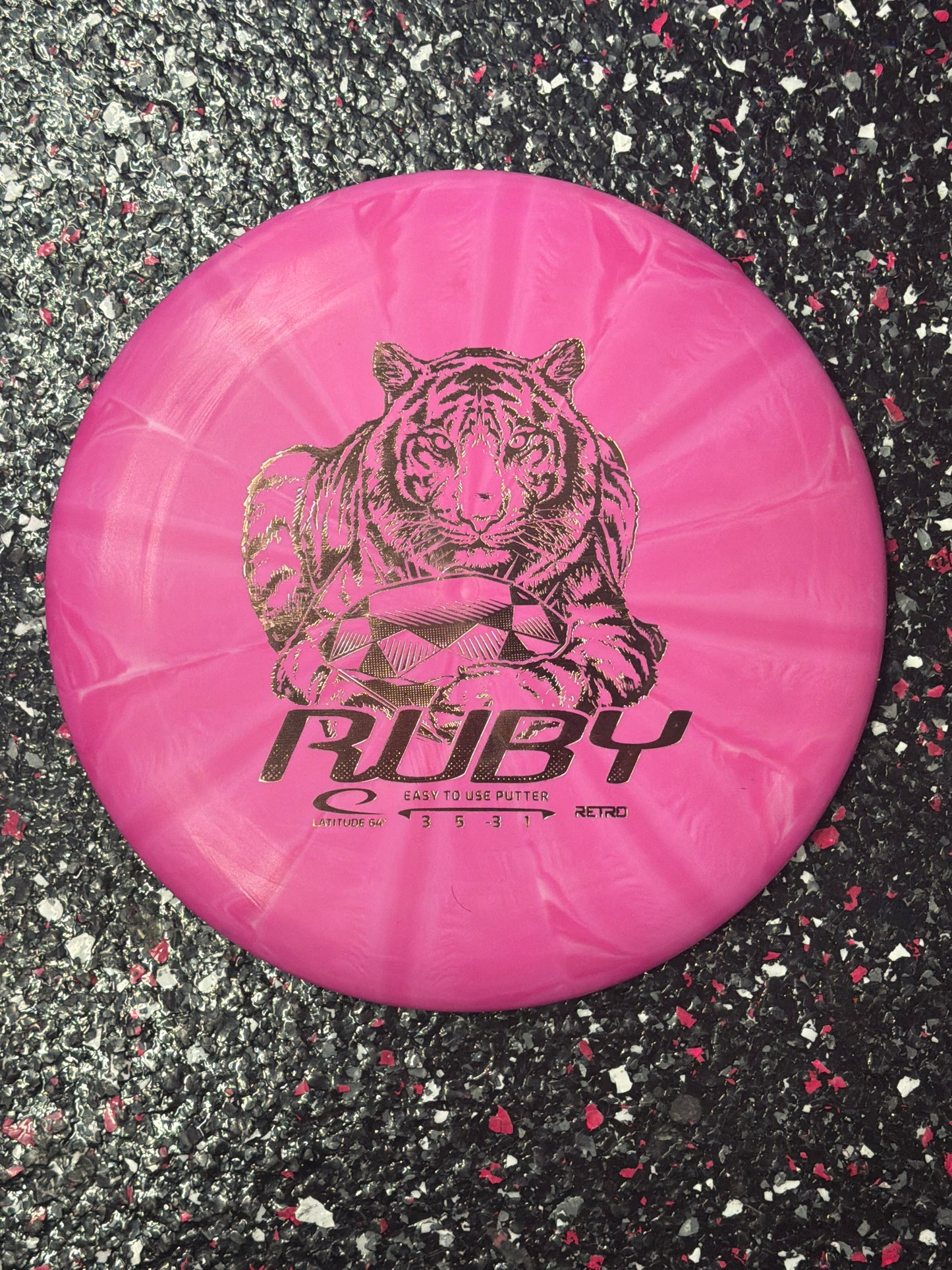
3/5/-3/1 Latitude 64 Ruby - Retro Burst
3/5/-3/1 Latitude 64 Ruby - Retro Burst
Couldn't load pickup availability
Rubies have spent centuries being treated like treasure. Kings wore them, warriors carried them for protection, and people with extremely expensive taste decided they represented passion, power, and good fortune. The Latitude 64 Ruby takes a slightly different approach: instead of sitting in a crown looking important, it gets beginners, lower-power players, and touch-shot specialists down the fairway without demanding the arm speed of a medieval siege weapon.
The Ruby is one of Latitude 64's easiest discs to throw. Its light, understable flight is designed to help the disc get moving, stay in the air, and drift right for a right-hand backhand player instead of immediately fading into the nearest patch of disappointment. In Retro Burst plastic, it also has that swirled, old-school look that makes every disc a little different. It is approachable, useful, and far less likely than an actual ruby to require armed security.
Flight
3 | 5 | -3 | 1 — The Ruby is a very understable, glide-heavy putt-and-approach disc built to create easy forward movement with modest power. The speed 3 rim feels comfortable and controllable, the glide rating of 5 helps it stay airborne, the -3 turn encourages it to move right for a right-hand backhand throw, and the gentle 1 fade gives it just enough finish to settle rather than crash.
For a brand-new player, those numbers mean the Ruby can actually fly instead of dumping left after forty feet. A smooth, flat release can produce a straight flight with a soft right drift. A little hyzer can help it flip toward flat and glide forward. Players who are still developing clean form will often see noticeably more distance from the Ruby than from a stable or overstable putter because the disc does not require high speed to activate its flight.
Intermediate players can use the Ruby as a specialty tool. It is excellent for controlled turnovers, touchy woods lines, low-power hyzer flips, standstill approaches, and shots where a forehand would be awkward or unavailable. Give it height and smooth spin, and it can hold a long drifting line without fighting aggressively back to the left.
Power throwers need to show restraint. Thrown hard and flat, the Ruby can turn quickly and may not return. That is not a defect; it is the entire point of the mold. Use reduced power, more hyzer, or extra height and it becomes a useful finesse disc. Try to throw it like a Firebird and it will leave the scene faster than someone who just realized the jewel in their pocket belongs to the crown.
In calm conditions or a tailwind, the Ruby can create surprising distance for such a slow disc. Into a headwind, however, its understability becomes much more noticeable. This is not the disc for forcing straight into heavy wind unless your actual goal is to explore the far right side of the property.
Plastic
Retro Burst is Latitude 64's grippy baseline plastic with a swirled burst appearance. It has a comfortable, slightly tacky feel that works well for putting, approaches, and controlled drives where a clean release matters more than maximum durability. The burst pattern gives each disc its own visual personality, so the Ruby looks less like a mass-produced tool and more like somebody stirred color into it while making questionable decisions near a paint mixer.
Retro plastic offers dependable grip in cool weather and dry conditions, and many players appreciate the way it feels in the hand compared with slicker premium blends. It will wear faster than Latitude 64's premium plastics, especially when repeatedly introduced to trees, pavement, rocks, baskets, garage doors, or any other object that was not part of the intended flight plan.
That wear can be useful on the Ruby. As Retro plastic seasons, the disc may become even easier to turn and shape at low power. Beginners often benefit from that extra workability, while experienced players can turn a seasoned Ruby into a dedicated roller, extreme turnover, or get-out-of-trouble disc. The tradeoff is simple: excellent grip and affordable performance, but less long-term resistance to damage than premium plastic.
Because Ruby discs are commonly produced in lighter weights, they are especially friendly for youth players, seniors, players with limited arm speed, and anyone who values effortless glide over brute-force stability. Lighter weights also respond more to wind, so choose your conditions wisely unless you enjoy watching a disc make independent travel plans.
Best Uses
- First putter or approach disc for brand-new players
- Low-power straight shots that need easy glide
- Hyzer-flip approaches through narrow wooded gaps
- Right-moving backhand shots for right-handed players
- Left-moving backhand shots for left-handed players
- Controlled turnover approaches that should not fade hard
- Standstill throws when footing or space is limited
- Youth, senior, and lower-arm-speed players
- Tailwind drives where extra glide is helpful
- Touch shots from awkward lies
- Learning release angles without fighting an overstable disc
- Short technical courses where placement matters more than power
- Developing a smooth, spin-focused throwing motion
- Seasoning into a roller or extreme-turnover utility disc
- Players who want a lightweight disc that does not behave like a brick with a logo
BDLD Real Talk
The Ruby is not trying to be everybody's main putter, wind fighter, forehand torque monster, or heroic meat hook. It is built to help the disc turn, glide, and stay moving with less power. For the right player, that is exactly what makes it so good. For the wrong player, it can look like the disc has developed a personal grudge against the left side of the fairway.
If you are new and most discs fade too early, bag the Ruby. If you struggle to generate distance with putters and mids, bag the Ruby. If you need a gentle turnover that holds instead of flexing out, bag the Ruby. If you regularly throw putters 300 feet with aggressive power, you can still use it, but you need finesse, hyzer, and the emotional maturity to stop blaming the disc after throwing it full blast into a headwind.
One of the biggest mistakes players make with very understable discs is trying to fix every bad result by throwing harder. The Ruby rewards smooth timing far more than violence. Start it on a little hyzer, keep the nose angle controlled, and let the glide do the work. When it turns correctly, it creates lines that more stable putters simply cannot reach without a forehand.
It is also a genuinely useful teaching disc. New players can see the relationship between release angle, nose angle, spin, and power without needing tournament-level arm speed. The Ruby gives feedback quickly: too much anhyzer and it turns into the ground; too much nose-up and it floats before stalling; clean and smooth and it glides like it has someplace better to be.
Retro Burst keeps the price friendly and the grip comfortable, which makes this an easy disc to recommend for beginners, casual players, families, and anyone building an affordable starter bag. Just understand that baseline plastic shows wear. Trees will leave receipts. Pavement will leave a full written review.
Compared with a stable putter, the Ruby is easier to turn and easier to get distance from at low power. Compared with a faster understable midrange, it is slower, more controllable, and better suited for short touch lines. It fills a specific role, and it fills that role extremely well: making flight accessible without requiring the thrower to wrestle the disc into cooperation.
Bottom Line
The Latitude 64 Ruby in Retro Burst is an easy-gliding, very understable 3-speed disc that helps newer and lower-power players create real flight instead of watching another disc fade out early. It is also a sneaky-good turnover and finesse tool for experienced players who understand touch. Buy it for the glide, keep it for the lines, and remember that sometimes the most valuable Ruby is the one you are willing to throw directly at a tree.
Share